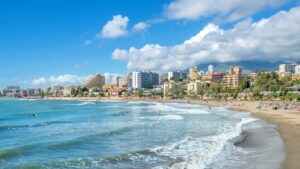
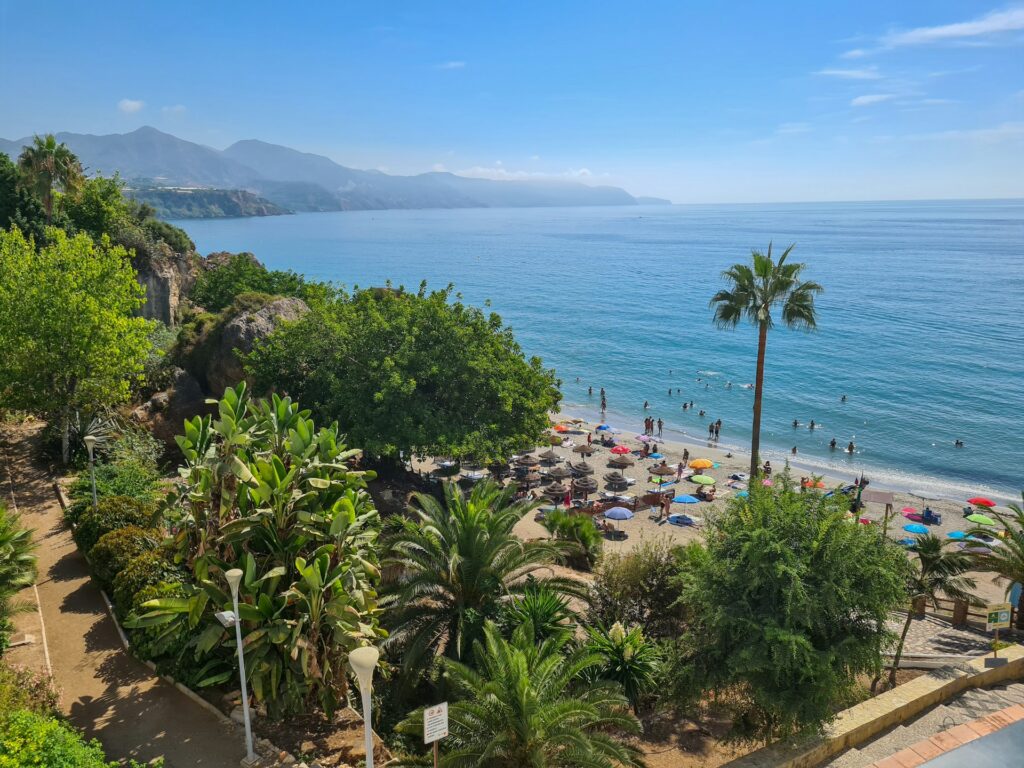
Long before the parasols and sea-view apartments, there were mines, a medieval scholar, watchtowers, and a castle that was never truly a castle.
Anyone visiting Benalmádena for the first time usually focuses on the obvious: the beach, the seafront promenade, and over 300 days of sunshine a year. What is not immediately apparent is that every corner of the municipality holds a history with far more layers than meet the eye. A name of Arabic origin, a medieval scientist, coastal watchtowers, two castles that beguile anyone looking at them, and a sculpture that ultimately became the symbol of an entire town. There is no need to invent anything: Benalmádena already has a story of its own.
A name that tells a story of its own
The most widely accepted explanation for the name Benalmádena traces back to the Arabic Ibn al-ma’din, an expression linked to mining that translates roughly as “sons of the mines”. It is a small detail, but it reveals something important: this is not a town that suddenly emerged with the tourism boom of the 1960s. It is a city with far older historical roots, which only come to light when one pauses to look beyond the coastline.
A medieval scholar and two towers still keeping watch over the coast
Few people realise that local tradition links Benalmádena to one of the most prominent figures in medieval science. Ibn al-Baytar, born around 1197, was one of the great botanists of his era and is considered a forerunner of modern pharmacology, having dedicated his life to studying how plants could heal. While historical sources debate his exact birthplace within the wider province of Málaga, the town claims him as its own, honouring his memory with a local school, a park, and a statue. In a location now synonymous with leisure and well-being, this figure was already devoting his work to that very concept centuries before health tourism even existed.
Dating from the Moorish period, two watchtowers can still be visited today: Torrebermeja and Torrequebrada, both built to scan the horizon long before sea-view balconies ever came into fashion.
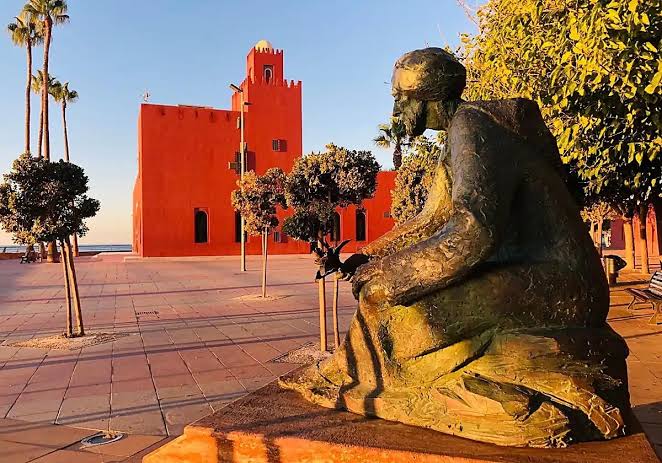
Statue of Ibn al-Baytar next to Bil Bil castle in Benalmádena.
The castle that was not born a castle: El Bil Bil
The building known as El Bil Bil Castle is quite possibly the most photographed landmark in Benalmádena. Its red façade, Moorish architecture, and seafront setting conjure up images of an ancient fortress. The reality is somewhat different: it was constructed around 1930 as a summer home for the Hermann family, built in an exotic style that was quite unusual for its time. It appears to be one thing yet is another, and that contrast is precisely what makes it so memorable.
The castle that never existed until 1987
A similar story applies to Colomares Castle. At first glance, it looks medieval, almost fairy-tale-like. In reality, it is a contemporary monument built between 1987 and 1994 by Dr Esteban Martín as a tribute to Christopher Columbus and the voyage to the New World. Tucked inside is a chapel measuring just 1.96 square metres dedicated to Saint Elizabeth of Hungary, which was recognised by the Guinness Book of Records as the smallest church in the world. Its blend of historical narrative, symbolic architecture, and fortress-like appearance makes it one of the most surprising spots for first-time visitors—and even for those who have lived just minutes away for years.
Water, factories, and a changing neighborhood: Arroyo de la Miel
Not all of Benalmádena’s history is housed in grand monuments. La Tajea, an 18th-century aqueduct, is the last remaining trace of a hydraulic network that powered something far larger: the industrial development of Arroyo de la Miel at the hands of Félix Solesio, a Genoese entrepreneur who established a complex of paper mills in the area. From that same era stands La Tribuna, a building that formed part of the original industrial site and remains integrated into daily life in the district. Before becoming one of the town’s most populous residential areas, Arroyo de la Miel was the economic engine of Benalmádena.
Another Benalmádena lies beneath the surface—and it all leads to a symbol
Long before the beach bars and the promenade arrived, this coastline was already thriving with trade and industry. Archaeological sites such as Benalroma, Los Molinillos, and the Roman villa of Torremuelle preserve the remains of ancient olive oil and fish-salting production, which can now be explored at the town’s History Centre.
Finally, there is one last symbol that captures this tapestry of history: La Niña de Benalmádena, a sculpture by Jaime Pimentel installed in Plaza de España in 1968. It is more than just a well-known artwork; over the years, it has become one of the defining images of the town’s welcoming spirit and the shared heritage of those who live here.
A place best understood through its history
Perhaps that is one of the reasons why so many people arrive in Benalmádena expecting a simple holiday and end up making it their home. Beyond the beaches, the marinas, and the climate lies a narrative that began long before modern tourism: a Roman past, an Andalusi legacy, an industrial heritage, and a historical identity that remains part of everyday life.
Discovering these stories does not just change how you visit Benalmádena—it changes how you experience living here.
If you are thinking of settling here, we at Hernán Bustos Real Estate Experts would be delighted to help you find the perfect place to write the next chapter of your story. Call us on +34 692 62 19 19.