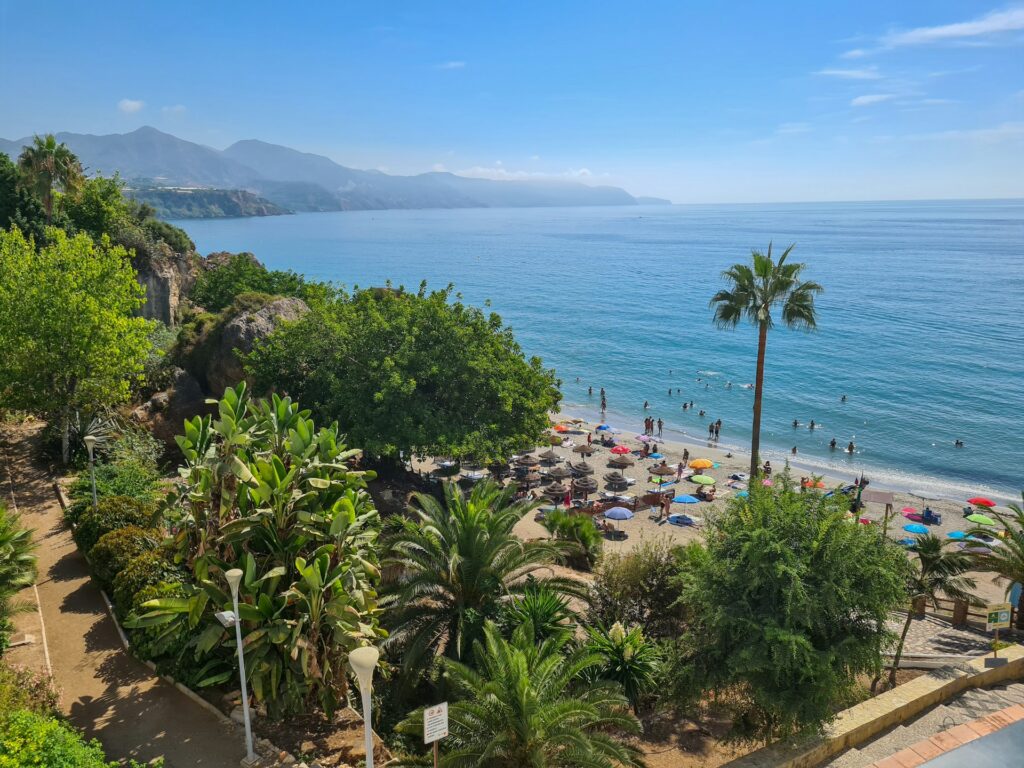
The real estate market on the Costa del Sol continues to rise, but no longer at the breakneck pace of the last two years. If you are thinking about buying, selling, or simply trying to understand what is happening before making a decision, this is the real outlook—backed by data, free of alarmist headlines, and without the fluff.
How 2026 Began: Record Highs Behind Us, Moderation Ahead
2025 was an exceptional year for Spanish real estate. A total of 714,237 housing transactions were closed nationwide—the second-highest figure in historical records, surpassed only by the 775,300 operations of 2007. In Málaga, the province concluded the year with over 36,800 sales, driven primarily by the new-build sector, which saw a 10.7% growth compared to the previous year.
However, the first quarter of 2026 sent a completely different signal. According to the latest data from the INE, Málaga accumulated 8,837 home sales between January and March, down from 9,741 during the same period in 2025. This represents a 9.3% year-on-year drop, nearly four times the national average decline of 2.6%.
Is this a cause for alarm? Not necessarily. Part of this drop can be attributed to the “base effect”: the start of 2025 was abnormally strong, posting sales increases of over 20%. Comparing any standard period against an exceptional quarter always leaves uncomfortable figures. Nevertheless, the trend is clear: after two years in which practically everything sold, the market is beginning to take its time. Even with a 6.5% decline in March, Andalusia continues to lead Spain with 12,494 transactions—the engine is still running, but it is no longer accelerating like it used to.
On a national level, March 2026 saw new-build sales drop by 10.2% year-on-year, while resale properties barely grew by 0.2%. This completely flips the script from 2025, when new construction was the main market driver. On the Costa del Sol, major developments aimed at mid-high income and international buyers maintain their pace, but local buyers, squeezed by record-high prices, are beginning to find themselves priced out of certain areas.
Will Prices Rise or Fall?
The short answer: they will continue to rise, but at a slower rate.
Forecasts from CaixaBank and Bankinter point to nationwide growth of 5% to 7% in 2026. In premium areas of the Costa del Sol, the estimated range is between 5% and 9%, depending heavily on the specific product type and its location.
The average asking price on the Costa del Sol currently floats around €5,120/m², revealing major differences between municipalities: Manilva stands at €3,640/m², Benalmádena at €4,724/m², Fuengirola at €5,395/m², and Marbella at €6,000/m². In ultra-prime districts like Puente Romano or Sierra Blanca, asking prices easily surpass €17,000/m² and, in select cases, reach up to €30,000/m².
Why aren’t prices dropping? There are three reinforcing reasons:
- A Severe Lack of Supply: The structural housing deficit in Spain is estimated at 700,000 units. While more homes are being built than five years ago, it is nowhere near the pace required to satisfy demand. In Málaga, nearly 9,500 housing permits were approved in 2025, yet only 335 were for social housing. New builds simply cannot keep up, and resale properties are scarce because many owners prefer not to sell at prices they deem insufficient—or they simply have no financial need to do so.
- International Demand: According to the Association of Land Registrars, 34.75% of all home purchases in the province of Málaga in 2025 were made by foreign nationals. Spain closed the year with a record 97,480 international transactions. In the Golden Triangle (Marbella-Benahavís-Estepona), this proportion exceeds 60%, and in the luxury segment, it nears 90%. The average international buyer has a purchasing power 80% higher than a local buyer. As long as this demand persists—and all indicators suggest it will—prices along the coast are not going to fall.
- Low Financial Leverage: Unlike in 2007, today’s market is not propped up by reckless or easy credit. In the first quarter of 2025, 34.5% of all property purchases were completed entirely in cash. This high percentage of cash buyers makes the market remarkably resilient to interest rate hikes. If you do not require financing, the Euribor is irrelevant to your transaction.
Several banking analysts, including BBVA Research and Bankinter, describe the current market as “overheated” due to the shortage of supply, but emphasize that it is not a speculative bubble like the one in 2007. The difference is fundamental: in 2007, there was an oversupply of properties coupled with a total lack of credit prudence. Today, there is a severe shortage of inventory and an abundance of genuine demand.
Mortgages: The Euribor and Your Pocketbook
The Euribor closed April 2026 at 2.747%, and the provisional average for May is hovering around 2.82%. This represents an increase of 0.74 percentage points compared to May 2025, when it stood at approximately 2.08%.
What does this mean in practical terms? For an average mortgage of €150,000 over 25 years with a 0.99% differential, the monthly payment increases by about €59 compared to last year—amounting to roughly €700 more per year. It is not catastrophic, but it is certainly noticeable.
The Central Bank maintains interest rates at 3.25%, but the economic backdrop has grown more complex in recent weeks. Philip Lane, Chief Economist of the ECB, recently indicated that at the upcoming meeting on June 11, they are likely to revise inflation forecasts upward—and they are not ruling out another interest rate hike. The catalyst: the conflict in the Middle East has pushed crude oil prices to around $100 a barrel, driving energy costs higher than anticipated. While Lane urged calm, describing any potential hike as “limited” rather than the start of a aggressive tightening cycle, the message is clear: anyone expecting rates to drop anytime soon will have to wait longer. If the energy crisis drags on, the cost of credit may go up before it goes down.
With inflation in Spain hitting 3.4% in March 2026 and geopolitical conflicts pressuring energy prices, fixed-rate mortgages stand out as the most prudent choice. The best market offers for May 2026 start at a 2.30% fixed interest rate (TIN), subject to standard relationship terms (salary deposits, direct debits, insurance). Variable rates start around Euribor + 0.49%, and mixed-rate mortgages are available from 1.75% for the initial period.
For those currently holding variable-rate mortgages, now is an excellent time to audit your terms and evaluate whether refinancing into a fixed or mixed rate makes financial sense. Every case is unique, but sitting tight out of pure inertia could prove costly if interest rates move upward in June and the Euribor continues its ascent.
On a side note regarding the State Housing Plan 2026-2030, which was approved in May with a budget of €7 billion: while it represents a notable political milestone—marking the first time all autonomous communities voted in favor—its real-world effects on housing supply will take years to materialize. It does not alter the short-term landscape for anyone buying or selling today.
If You Are Thinking About Selling
Market conditions remain highly favorable. Prices are resting at all-time highs and demand, though far more selective than a year ago, remains robust. However, there is an important caveat: the buyer of 2026 is no longer the buyer of 2024. Today’s buyers compare more, take longer to decide, and show zero tolerance for an overinflated price.
The average time a property spends on the market has lengthened. Homes that enter the market with a realistic price, professional presentation, and fully organized documentation continue to sell within reasonable timeframes. Conversely, those launched with an “aspirational” price—waiting for “the market to catch up”—simply stagnate. And a stagnant listing loses its digital credibility very quickly on major portals.
My reading: selling in 2026 makes complete sense if you want or need to do so, but your pricing strategy matters more than ever before. Setting the correct initial asking price isn’t being conservative—it is being professional.
If You Are Thinking About Buying
Do not wait for a widespread drop in prices. The core market fundamentals (scarce supply, sustained international demand, low financial leverage) simply do not support that outcome. What you can expect to find is significantly more room for negotiation than a year ago in certain segments and locations, particularly among resale properties that have been sitting on the market for a while.
If you plan to secure financing, lock down your maximum borrowing capacity before falling in love with a property. The Euribor is not going to plummet tomorrow—and with the central bank signaling a potential interest rate hike in June, the cost of borrowing could worsen before it improves. The monthly payment you can comfortably afford right now is the only number that matters. If your budget only works on the assumption of interest rates at 1.5%, you aren’t buying a home—you are buying a financial risk.
And if you are a cash buyer, your bargaining power is stronger than you think—especially when targeting properties that have accumulated substantial days on market.
What Lies Ahead: Not All Agencies Work the Same Way
In our next piece, we are going to dive straight into a topic that directly impacts buyers and sellers alike, yet is rarely explained transparently: the actual operational differences between working with a boutique real estate agency versus a traditional corporate franchise.
This isn’t about deciding which model is universally “better” in an abstract sense; it is about understanding which structure fits your specific situation, your property type, and your financial goals. In a market where precise pricing and strategy mean the difference between selling successfully and selling poorly, the professional you choose to stand beside you matters a great deal.
Disclaimer: This article is for informational purposes only and does not constitute formal financial, legal, or tax advice. For specific guidance regarding real estate decisions on the Costa del Sol, always consult a qualified professional.